Before any music production began on my EP I first started by researching examples of music that followed both West and East coast synthesis techniques to get an idea of how other artists have used these synthesisers to chase their idea of the perfect modular sound. The first thing I came across in my research was a small playlist of Mini Moog Model D samples showing off the basic capabilities of the synthesiser. https://soundcloud.com/moogmusicinc/1-west-coast/sets Alongside this i also came across a playlist of Buchla samples. https://soundcloud.com/chris_whitten/sets/tm6-pro-buchla-samples Despite how simple these short clips are it was a good reminder of how vastly different the tones of both types of synthesiser can be as well as a look into what kind of sounds I can be looking to utilise within my own work.
I then started listening through more lengthily compositions such as this Buchla improvisation session posted on Soundcloud https://soundcloud.com/user7621213/buchla-improv-11-3-12 This perfectly showcased the kind of haunting drone sounds you can achieve through a Buchla system and prompted me to want to include a drone piece within my EP. As well as the drone capabilities of Buchla synthesisers, this recording also shows use of the Buchla’s source of uncertainty module which creates random voltages, the idea of quantised random voltages was definitely something I wanted to experiment with within my EP.
On the other end of the spectrum, this short clip of a distorted Moog filter sweep shows some of the more dirty sounds you can get out of the East coast synthesis sound. Despite being used for more conventional purposes within the music industry, this is a good example of some of the interesting and experimental sounds that people achieve. https://soundcloud.com/socialistsynthesis/nasty-tempo-synced-moog-filter-sweeps when it comes to east coast style compositions it has always been this aspect that has interested me, another example of heavier distorted east coast synthesis would be Canute by Petrels which features ambient tones that slowly morph into distortion and chaos. This is one composition that I saved and came back to for inspiration when starting my first track of the EP. https://soundcloud.com/floatinglimb/petrels-canute
After a while of listening to compositions created on the Buchla I came across the first track during my research that resemble something with a structure and pattern to it. The song, Buchla’s Dreaming by Adriatique stood out against the experimental pieces littered all over Soundcloud because despite the structure and regular melody to the song, it still held those quirky characteristics that told me definitively it was created on a Buchla instrument. https://soundcloud.com/afterlifeofc/adriatique-buchlas-dreaming
A really helpful playlist I found on Spotify called “buchla and beyond” which showcased a number of regular songs that featured modular synthesis as oppose to solely being a composition created with modular. Great examples from this playlist such as Native State by Kontravoid and Ghosts by Japan have helped show me how modular synthesis can be used to compliment other instruments as well as form the very structure of a ‘pop’ song. Another playlist I’ve been taking inspiration from is “21 awesome tracks made with a modular synth” which includes the more generic synth only modular compositions such as Makmba which caught my attention in-particular for the use of seemingly random melodic notes, potentially created using quantised random voltages. Tiptopbd808 also caught my attention for its use of white noise as a snare which I decided I would look into for my experimental track. One of my favourite west coast style tracks I discovered during my research is Blood by Nathan Moody, again utilising quantised random voltages to create a piece that does not follow any tempo. I feel like a big part of why this style works so well is that you never know where the track is heading next, its keeps you on the edge of your seat in anticipation.
I decided to start my EP with the experimental track first as at this time I was still researching for inspiration on the East and West coast style tracks. I started the track off by creating a kick drum, I attempted this in a different way than I had previously in the weekly task submission. using a signal from row one of the sequencer, through a low pass filter and into a distortion module with the gain turned up relatively high, this system creates the kick sound as well as an additional snare type sound in-between each kick.

I had originally planned on using both of the drums in their original configuration together but it did not end up working with the style of the song as what could have been the snare did not seem powerful enough to be the main snare within the track, once recorded into logic I decided to separate the snare sounding drum out and use it as its own sample. This snare instrument can be heard with a small amount of delay on it every so often over the top of the kick to compliment it, its a very simple drum pattern but I feel that it works and fits the style of the song. Whenever I felt like I wanted the drums to delay a few more times I would double up the existing tracks within logic to achieve a much more staggered effect.
A low LFO wobble can also be heard at the start of the track and plays throughout constantly providing extra support for the drums.
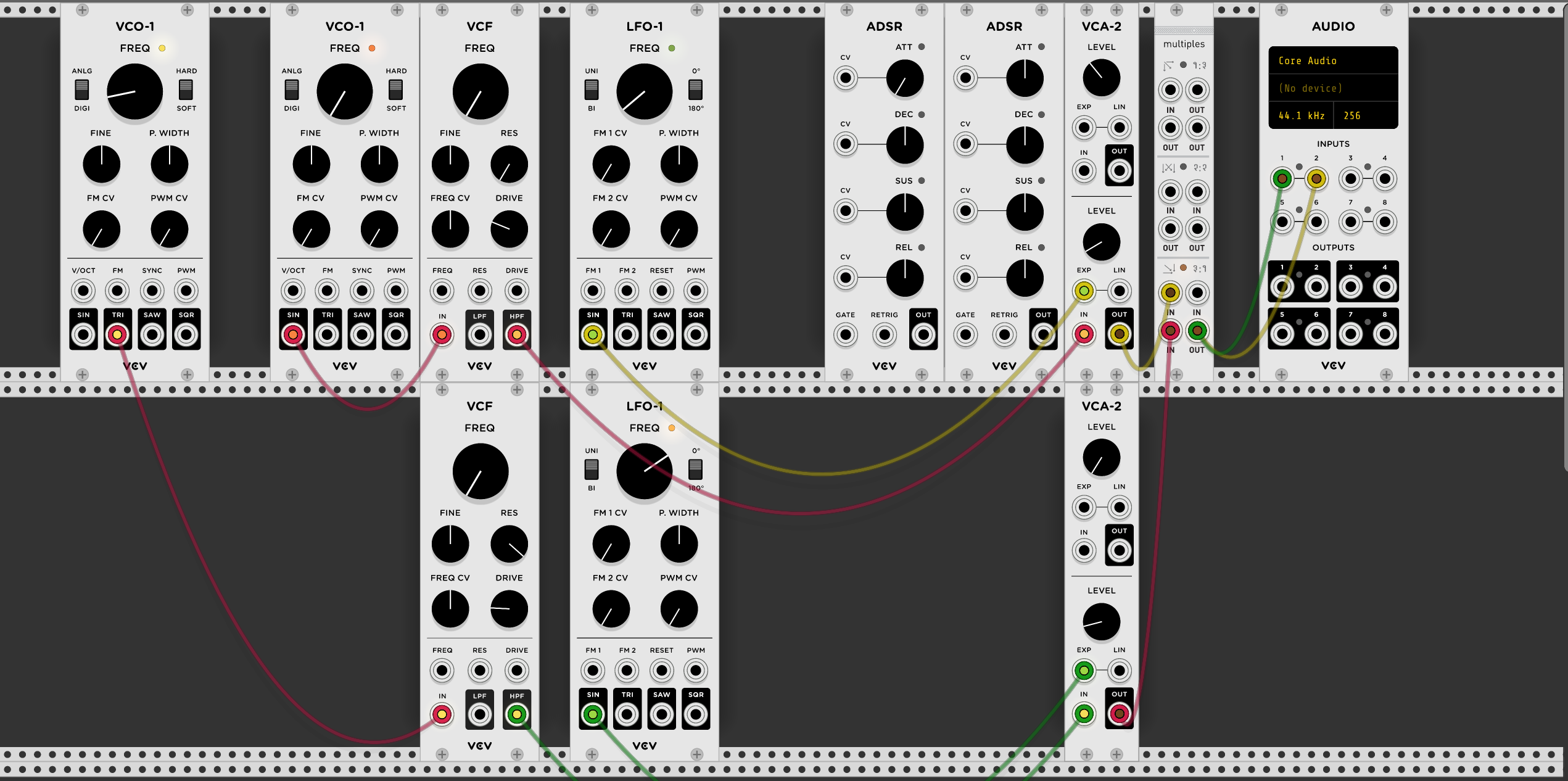
The central piece of this track would have to be the sequenced melody that begins to play after a short introduction. While working on the LFO for this song it was decided that the BPM would set be 122 and that the drums LFO and melody would all be perfectly in time with each other. While testing the melody sequence I found that it was although in time, it was too slow for the pace of the song. In an attempt to fix the speed of the melody quickly, I doubled the BPM on the clock and to my surprise it sped up to what I believe is the perfect amount.
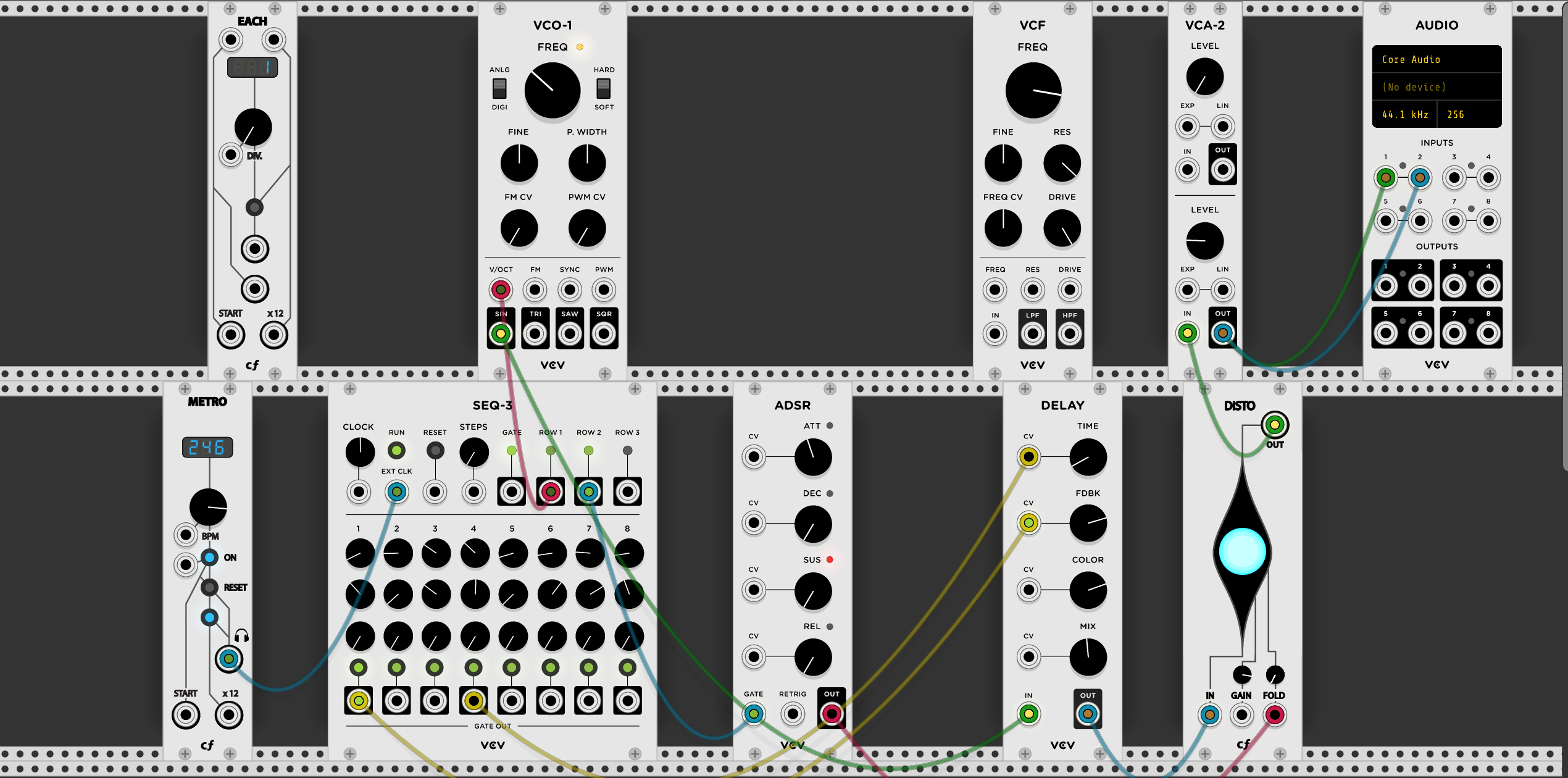
A second melody was later added to introduce a bit more variety to later sections of the song, this melody, although somewhat in tune with the original, was designed to sound a little random in the style of the Buchla’s quantised random voltages module. Alongside this melody, a bass synth was introduced to produce a constant background buzz while the song builds up around it. As mentioned earlier on I was heavily inspired by a song called Tiptopbd808 that used white noise in place of a snare within the drum pattern of the song. As this is my experimental song I decided to integrate the noise based snare into this song.

In the patch shown above, a square waveform is being passed through both a high pass filter and distortion module to create a noise effect. Alongside this the gate signal of the sequencer is triggering the VCO through the one volt per octave input but because all of the pitch/frequency knobs are turned down in the same position it simply acts as a trigger for the noise. To ensure each snare/noise hit fitted well into the song, I decided to record one hit of the snare and use logic to program the drums in when and where they are needed with ease.
Once I had finished arranging the experimental piece, I decided to move on to the East coast composition as I wanted to experiment with the gritty distorted synth sound I mentioned earlier in the blog. While gathering ideas and planning out basic patches for this song I decided to make a few distorted oscillator patches that I could experiment with and record while I played, this resulted in a lot of sorting through to find usable audio for background and intro synth parts. The first of which comes from the introduction filter sweep, this filter sweep was inspired heavily by the distorted ending to the song Canute by Petrels that I mentioned previously.
This next screenshot shows how I created both the snare and hi-hat sounds within this track, adjusting settings on the ADSR allowed me to control how long or short the hit was. At the time I was only planning on creating a hi-hat sound to have playing throughout the song but the snare sound came out through some trial and error with the patch as well as experimentation with envelope settings. Similarly to the previous track, I decided to cut the hi-hat sound from the recording to be implemented through logics sampler.

The next patch displayed shows how I created one of the LFO bass sequences that plays through the vast majority of the track. Featuring three VCO’s, VCA’s and one LFO controlling them all I felt that this was quiet a big sound and it fit perfectly within the track. The LFO rate was a parameter that I experimented with adjusting but it didn’t produce the best results so instead ended up leaving it as it was.

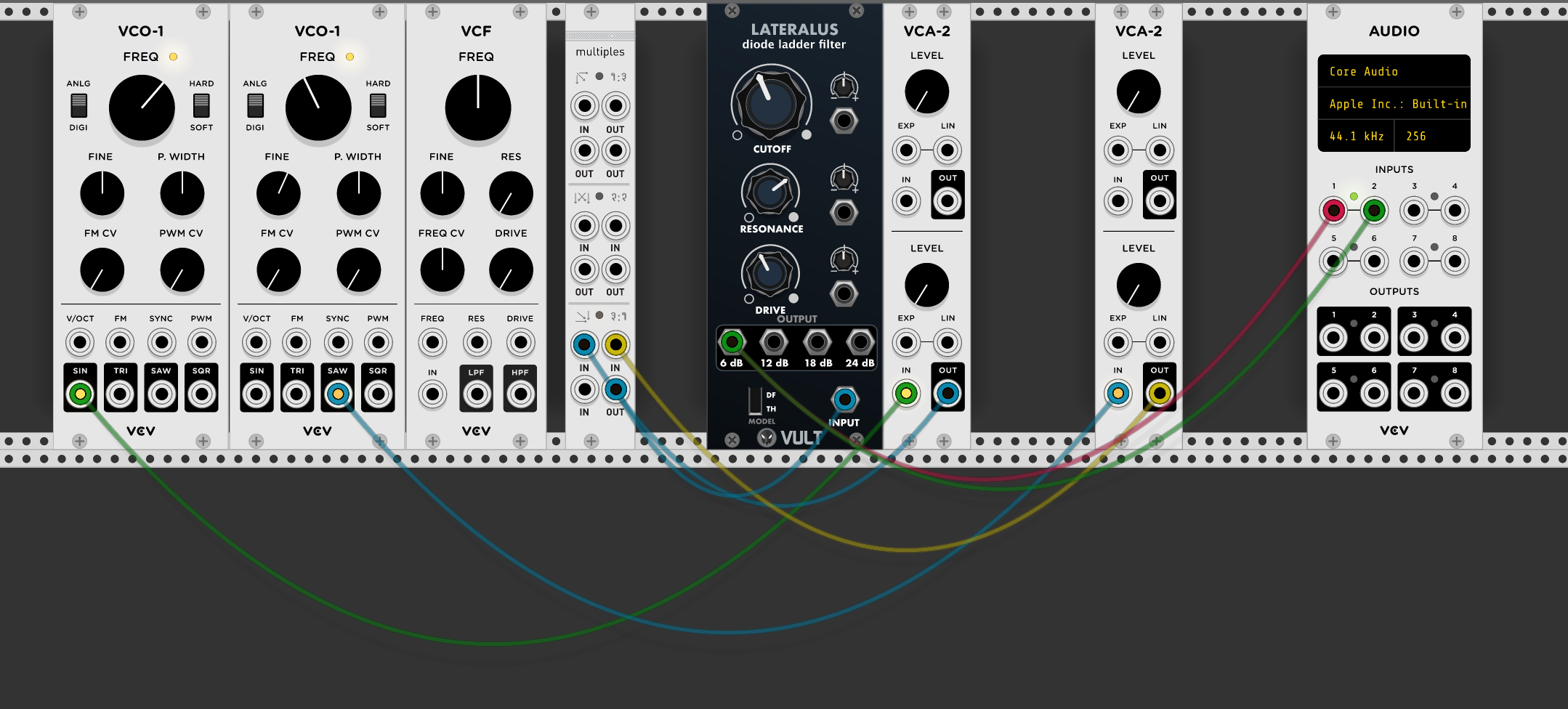
In the next screenshot you can see the patch that was used to create each of the distorted notes within the chorus of this track, I played around with sequencing each of the notes but this did not achieve the results that I was looking for. In the end I tuned all of the three VCO’s to the notes I wanted all together and then modulated one of the VCF frequencies by hand while recording to achieve a sweeping sound, each of these notes were then carefully cut out and pieced together to form the chorus. Getting the harmonies of each VCO’ correct in context with the rest of the song was a bit tricky as I couldn’t listen to the other notes to hear whether the tuning was correct while recording, this meant that I wouldn’t know if the pitch was off until it was recorded and played back in context. I also decided to include an additional oscillator to this section of the track which included an octave setting, giving me more precise control over the chords.

In this image bellow I have included another one of few bass undertones that can be heard throughout the track. This bass line is a slow moving sequence that builds up tension towards the chorus section.

As this was my East coast style track I planned out a more obvious intro verse and chorus in comparison to the other tracks included on this EP. Overall I used a lot more VCF modules and ladder filters than I would usually have done, but I feel that it proved to be a positive as I am happy with the end result and the fact that it represents the characteristics of this style of synthesis .

Alongside the main compositions I had been working on for this EP I had also been looking into drone music and how that could be incorporated into my patches and music more. Similarly to my drone patch from my weekly task submission, I wanted to utilise the delay, distortion and LFO modules to see what kind of crazy sounds I could get feeding back through each other. After leaving the drone on record for a while and adjusting some of the parameters such as speeding up the time of delay or the rate of the LFO to increase feedback when needed, I recorded a drone that I felt showcased the ability of my patch. Below I have included a screenshot of the patch.

For the fourth song of this EP I had to replicate the sound of West coast synthesis, I wanted to use a random voltage generator module to create an uncertainty within the song when it came to the pitch of the main synth melody. I didn’t want to include any drums within the track as I did not want it to have a set tempo, I wanted my track to embody this key characteristic of the West coast synthesis style. The first screenshot I have provided showcase wavetable synthesis, I used the scanner module to morph between 6 different waveforms. The scan input is being modulated by an LFO that sweeps through the different waveforms. I also decided to affect the width and slope controls through rows one and two of the sequencer. Each oscillator output from the scanner has also been passed through a delay module set at different time and feedback amounts to add more variety to the sound. This provided the ambient droning background audio within the track.

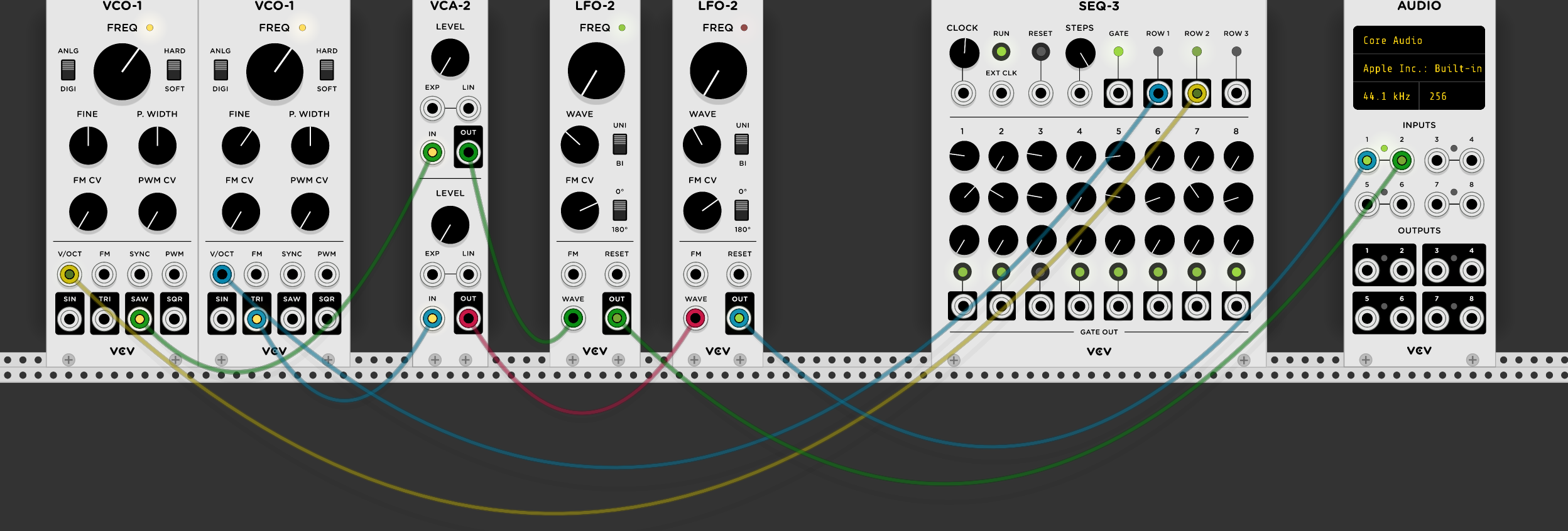
The next screenshot that I have provided shows the FM synthesis that I used to create the intro audio that plays through most of the song in the background. On the left, the VCO is sending a sine wave straight to the VCA while the VCO on the right is using a triangle waveform to modulate the CV input of the sine wave. After getting some interesting sounds from this alone, I decided to see what it would be like if the pitch of the sine wave was also being controlled by a sequencer through the one volt per octave input. To top it off we also have an LFO modulating the pitch of the triangle wave form through the one volt per octave input. Im am really happy with the result of this patch and decided to use it as the introduction for the track.
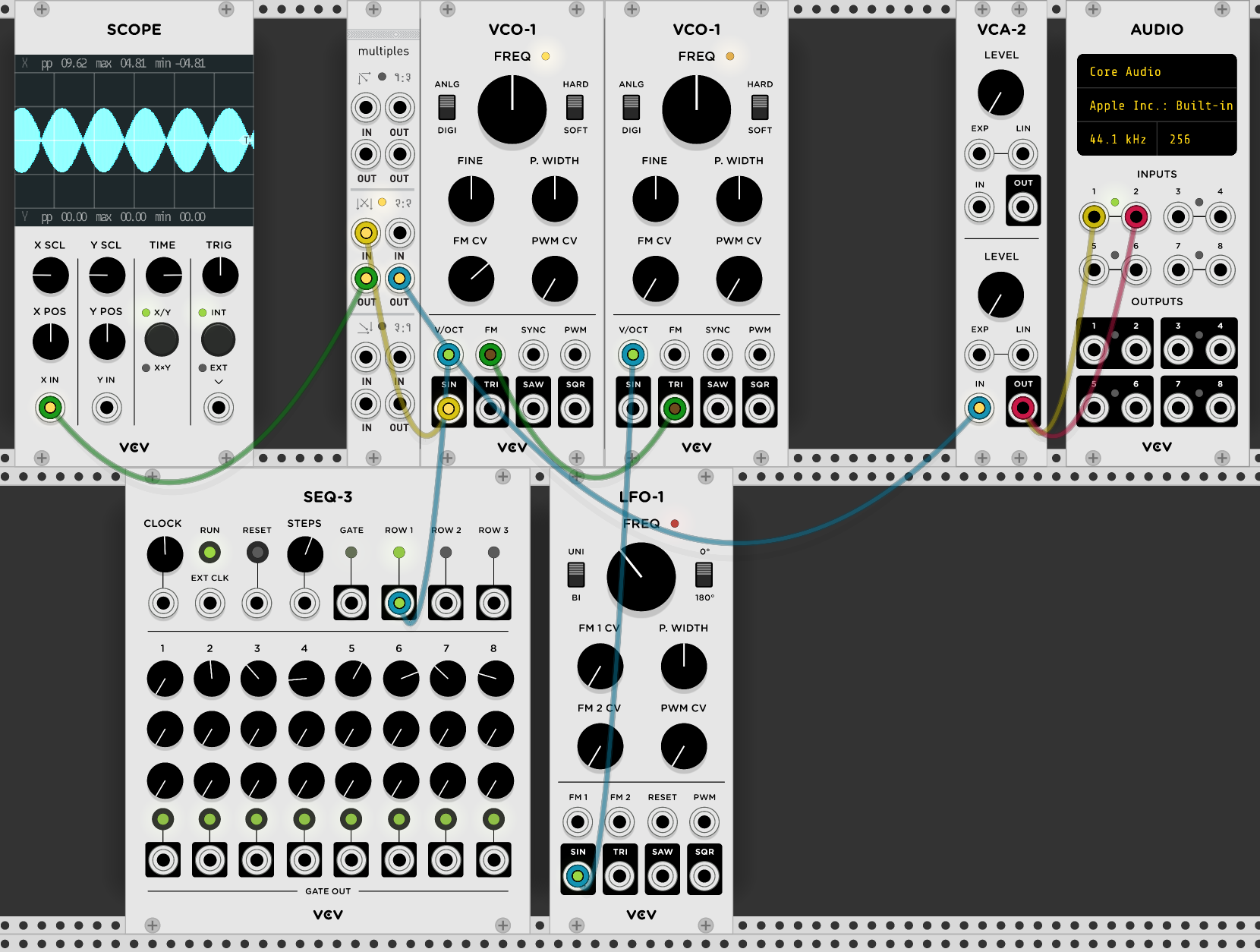
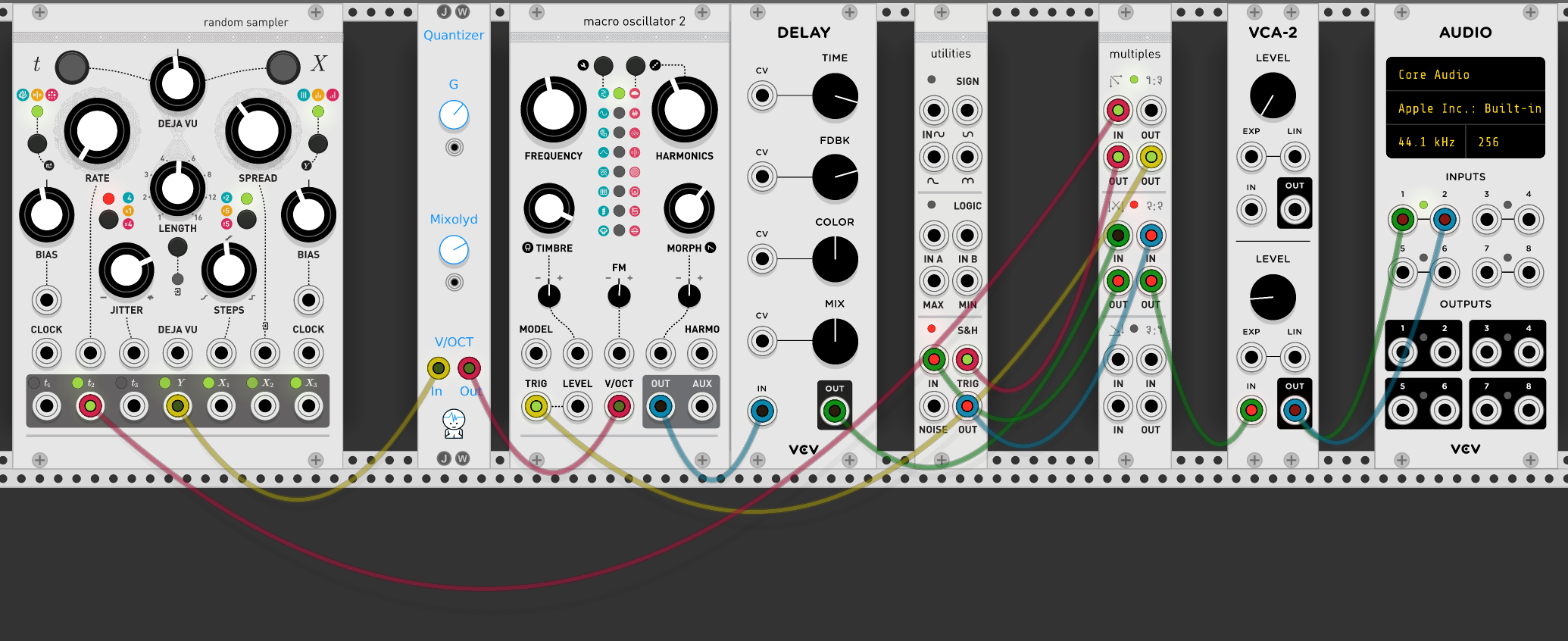
When trying to replicate sound similar to that of the Buchla, one of my main goals was to use a random voltage generator like this one in the screenshot below. I felt that this was a key factor to the sound of west coast synthesis and had a vision of what it would sound like within this track. i connected the random sample generator to a quantiser which allowed me to set a key that the sampler would choose notes from, this meant that although the notes would be chosen completely at random, i could choose a key that would work with the background ambient audio that wouldn’t sound off to the listener. Just to add that additional layer of texture, I also decided to connect the output of the macro oscillator to a delay module with the time and feedback controls turned up fairly high. The result is a sonic maze of trailing notes and nuances.
Below i have included an image of my EP artwork. This is a photograph of a crowd that I took at a concert, the photograph has been wrapped around itself and layered with effects and distortion similarly to the signals that pass through modular synthesisers.
My EP is called
South Coast Synthesis



 Music and Sound Synthesis CT6MASS